02 October 2016

Far side DXing: October 2016


Oct 2: the Oceania DX contest phone section got off to a slow start with poor LF conditions last night and not much better on HF this morning, but this afternoon I found a few stations lurking on 15m and this evening I had a little European run on 40m. In other words it was patchy.

Oct 7: LoTW confirmations arrived from TO5FP including our remarkable 80m RTTY QSO ...


Oct 8: today I completed a little job that has been on the go for about a year - I put in a base for a prop to support the tiltover tower when it is tilted. It took two attempts: yesterday I used some old premix concrete that was kicking around in the workshop for an indeterminate period, probably a couple of years or more. It didn't set overnight so I dig it out and today I bought 30 kg of new fast-set readymix. This stuff starts setting almost as soon as the water goes in, so it was a race between me and the concrete to fill the hole. I won!


Oct 9: I got up at 2:30am local for the CW leg of the Oceania DX contest only to find 80m unusable due to severe QRN from a storm front linking Brisbane to Auckland:


40m wasn't too bad though. During the day I messed around on 15m and chased after S9YY, a German group on Sao Tome and Principe Island, eventually catching them on 17m.  Back to 40m for ZL dusk, and something over 300 40m QSOs in the log before I got bored and wandered off ...


Oct 10: the Oceania DX contest website is QRV again today after exceeding its bandwidth limit last night (doh). I guess that means the website is popular!


I got up early again to find 80m in good shape today. Kamal 4S7AB called me for a new DXCC on 80. I hope this time he QSLs. 


I spent quite a while fruitlessly calling an Estonian on 80/CW. I don't think he heard me at all but someone tried to 'help' which just confused matters. Not to worry, I'll try again another day. 


Just as the band creaked open this morning, S9YY was on 20/CW with a wide split and few IDs. Not a bad long path signal though with lots of Europeans calling them.


Oct 11: I've had 2 more QSOs with T31T today, including a surprisingly difficult one on 15/CW. This morning, they were strong on 15/CW, working NA so beaming directly away from me. I called them half-heartedly while working, then gave up and left them to their pile. This afternoon, I tried again as they were working JAs, beaming away from me and not so strong. I heard them work a VK and I think a ZL, so I tried a bit harder and eventually they heard me. I had to repeat my call for them maybe 3 times, despite running about 800 watts out to a 5 ele Yagi. I caught them on 30/RTTY this evening too, much easier despite the crowded band full of loud EU callers.


Oct 12: I'm finding the bright, crisp little P3 panadapter display surprisingly useful. I occasionally used a FunCube USB dongle and panadapter software in much the same way previously but it took some setting up, the software was flaky and it was tricky to set aside enough monitor space for the display. It had one advantage over the P3, though, which was to display callsigns from DXcluster spots at the relevant places on the waterfall. The P3 is easier to run: drawing just a few hundred milliamps from the K3 accessory output socket, it springs to life when I turn on the K3 and just sits there quietly doing its thing. I use it mostly to monitor DX signals and look either for callers in QSO with them or for holes in their pileups, and to find signals on quiet bands.


That's a screen-grab from the P3 of Stan H40GC working a pileup of JAs on 15m SSB. The wiggly yellow line shows near-instantanteous signal strengths across a 20 kHz slice of the band (taken from the K3's IF output), with my noise floor at about -145 dB.  The blue area below is like a chart recorder, constantly streaming downwards and showing signals varying in strength over time by the brightness of the bluey-green marks. The red strip shows my subreceiver monitoring Stan on 21270 kHz, while the green strip shows my transmit VFO just over 5 kHz HF, at the bottom of his split range "listening 5 to 10 up". There were 3 or 4 JAs calling stan, evenly distributed in his receive range. [I've added some text - H40GC and Pileup - plus the white bar showing the pileup, in a graphics editor. Those aren't on the P3 display.] 


Aside from QSLing 100% via Logbook of the World, I am sending out about 500 QSL cards per year, on average, the majority via GlobalQSL:


GlobalQSL charges just over US$100 (about NZ$150) for 1000 cards, so those QSL cards are costing me about $75 per year, about 20 cents per day. I send some direct cards too, about one envelope every two months of my own plus one per week responding to incoming direct requests, and I contribute about $300 to DXpeditions per year in donations and OQRS fees.  I'm spending roughly $1,000 per year on equipment, but recoup about a third of that through second hand sales. I don't know how much the shack electricity costs: perhaps I should check.

By comparison, it would cost me $1,100 per year just to join the local Napier golf club, plus the cost of clubs, balls, checkered trousers, a trundler trolley and a daft cap, plus diesel for the 50km round trips. Amateur radio is in the same ballpark, and I know which one I'd rather do!

Oct 15: there are several strong DX sigs on 80/CW this morning but none of them can hear me. ER1SS is calling CQ OC with short 'listening' gaps. DK1WI and RW9JZ are also CQing with no hint of hearing me. Admittedly it is now about 20 mins after dawn though, so perhaps the D-layer is already fully absorbant today.

At lunchtime today, Logger32 started spewing out errors due to DXcluster spots, specifically RTTY spots from a Japanese Skimmer ...


The above message causes cluster processing to hang until I click the OK button, whereupon a little sequence of further errors appears, all of which also need to be individually OK'd before cluster processing resumes ... until the next spot from 7L4IOU arrives, more specifically "7L4IOU: -#".  It looks to me like maybe he has forgotten to set the call modifier number for his Skimmer node e.g. 7L4IOU-5 (or whatever), so it is sending out spots with his callsign followed by the hash character whereas Logger32 is expecting an integer. Possibly. Anyway, it's an annoying bug because of all those confirmation clicks needed to clear it and no obvious way to stop the errors within Logger32 other than turn off the cluster feed (shock! horror!). 

I tried filtering out 7L4IOU spots using the filter option in VE7CC Cluster User software, but that didn't work. Maybe I should be filtering on 7L4IOU-#? I don't know, since there is precious little help in or on Cluster User. Perhaps the filtering only works on spotted calls, not spotters? 

Next option was to apply cluster filtering within Logger32:


Success! That seems to have done the trick. Luckily, the originator blocking filter is evidently applied before module ClusterProcessing is called, and it looks like ClusterProcessing could do with additional input checks for invalid originator callsigns.

Inspired by a photo of a similar but much more elegantly crafted design by W0GJ, I've made my first ever whirligig today:


It's very rough-n-ready, unfinished, a prototype really just to figure out the mechanics and learn what works ... or doesn't. 

The propeller part worked out surprisingly well: six strips of thin steel pushed into 45-degree slits in a plywood wheel, each one held in place with glue and a wood screw. The drive shaft running the length of the crossbar is a scrap of tubing, not straight as it turned out (one of the learning points from today!), running in two short offcuts of aluminium tubing glue-gunned in place as simple sleeve bearings. The actuator at the rear is, now, a small plywood wheel with a bent metal rod linking it to the end of the arm. Originally I tried a wooden cam but immediately discovered that slack in the arm's 'axle' (bent rod again) allowed the arm to twist under pressure from the cam - so that's another learning point. The finger presses down on a crude Morse key, hand-fashioned from a scrap of treated wood and supported on a base with more bent rod. 

I added a tail made from two scraps of ply to turn it in the wind, the whole contraption spinning on a metal rod sitting in some tubing in the end of the green support now screwed to a fence post for testing.

If there's enough wind tomorrow, I'll grab some video showing the hand tapping out a series of dots. It does need a fair blow of wind to run - with hindsight, the propeller should probably have used wider vanes, although there's room to add another 6 between the first 6. The metal link at the rear needs more work too: currently it is just a press fit into the actuator wheel and the rear of the arm but it works its way loose. I somehow need to stop it sliding out horizontally backwards while still allowing rotational movement - maybe a circlip and washer in a void cut into the arm or a nut and washer on the front face of the wheel.

I must keep an eye out for a cheapo secondhand Morse key for the Mark II version, rather than that crude wooden monstrosity. And a better axle for the arm, plus a more anatomically-correct arm, maybe rescued from a shop mannekin, would be good too.

But, for now, the prototype is done. It took me 5 hours messing around in the workshop, though it seemed half as long so I guess I was in flow. All in all, a fun way to spend a damp Saturday afternoon.

Oct 17: CQ CQ CQ ...


I think I've finally figured out a way to get Logger32 to QSY the radio so that a spotted RTTY station comes up at the default receive frequencies in GRITTY: the trick is to set the MMVARI "Preset Audio frequencies" to 2285 Hz in the MMVARI settings:


MMVARI is still offset (it puts itself 85 Hz above the spotted frequency, as if spotters are reporting the mid-point frequency instead of the mark), but GRITTY is on frequency. Normally I only use MMVARI for transmitting, generally twiddling around to find a hole in someone's pileup, so the MMVARI offset is a minor annoyance.

The menu buttons in GRITTY aren't entirely obvious with no pop-up tooltips and a not-exactly-helpful help file, so here's a crib for the important bits:


9N7XW is on 17/RTTY this evening, weak, working simplex and, of course, he is being mobbed by JA and UA callers. If he would operate split across a reasonable range (up 1-2 or 1-3 would be enough), I might stand a chance but not simplex.  After calling for some while, I saw 9N7ZT spotted on 20/CW, working split, so I QSYd, tuned-in to his callers and worked him with 2 calls, easy peasy.  I've retuned to 17/RTTY now to find 9N7XW and a never-ending stream of JAs still slogging it out simplex. I wonder if they will be in Nepal long enough to work out the JA seam?

Oct 18: the planets aligned, for once. Franz OE7FMH emailed me yesterday, saying that he'd heard me on 40/RTTY calling S9YY yesterday, and could we perhaps make a QSO for a new slot.  I agreed and arranged to be on the band by 0530z today. I got there about 30 mins early to set things up and check out MMVARI and soundcard settings - good thing too as I'd messed up the configs earlier today. Anyway, it was soon resolved and I was on the air, when Franz emailed me to say he was up early and raring to go. I replied with a frequency and started calling him. Moments later, he called me and we completed a QSO, for probably the most straightforward and painless sked I've had.


I signed and uploaded the QSO to LoTW at 0522z and emailed Franz my sincere thanks for a very efficient exchange - quite a contrast to the usual kerfuffle when people ask me for skeds but can't hear me or haven't dampened their string, leading to days or weeks of torment as we try to establish contact. We usually make it, in the end, but the fun has drained out by about the fifth attempt: it's just a slog from there (unless it's a new slot for me too!!).

Oct 19: it looks as if, within the next few days, we will exceed last year's total of 1,169 logs submitted for the OCDX contest:


I've stumbled across a bug in Rick N2AMG's LOTW/EQSL synchroniser add-on for Logger32.  I accidentally clicked the Download LOTW QSL button twice. The second click, while the info was still downloading, brought up a run-time error message as the add-on crashed:


It's no big deal to restart the add-on, or to avoid double-clicking the download button in the first place. Thinking perhaps I ought to report the bug to Rick, I decided to check whether I am using the latest version. According to the program I am ...


... but according to Rick's website, the latest version is not 1.4.99 but 1.5.01:


I dutifully downloaded the updater but when I went to install it, WinZip told me it has the same size and date/time stamp as the file I am current using after all:


... at which point my goodwill and spare time almost ran out (I have sent Rick info about the bugs etc. since it appears he is working on a new version of the utility).

This evening, I tamed an unruly EU pileup on 30m - or at least retained what remains of my sanity - by spliting down 1 for a change. I had been troubled by a couple of VKs chatting away on SSB just HF of me (yes, on 30m!) and the usual, expected, anticipated and feared antisocial, not to say ignorant and obnoxious EU zoo, so the down-split made sense. None - not one -  of the Europeans who had been clambering over the top of each other and calling through my QSOs evidently copied or understood "CQ DN1" ... but OT and FB CW op W6LFB did, so we had a very pleasant QSO - me on my new-fangled Bencher and Winkeyer, he on a WW2 Navy J38 straight key. I'm somewhat ashamed to admit that his fist was not only nicer sounding but more accurate than mine  :-)  Tnx Jim in Dallas, it was a real pleasure, again. I am looking forward to many more QSOs OC, and patiently hoping that the EU rabble will eventually twig that their antisocial on-air me-me-me antics simply aren't productive. Life's too short.

Here's another bug or design flaw in the LoTW/Logger32 exchange, as demonstrated by one of my two QSOs yesterday with Franz OE7FMH. The 40m RTTY QSO is the problem: yesterday  I completed a 40/RTTY QSO, on sked, with Franz as I reported earlier and signed and uploaded the QSO info to LoTW shortly thereafter. Franz duly signed and uploaded his QSO info also, and LoTW matched the two records. So far so good.  However, somewhere along the line, the mode has been variously recorded or reported as "DIG" and "RTTY" ... and it appears Logger32 and/or N2AMG's syncher can't handle that discrepancy. L32 refused to synchronize the inbound LoTW confirmation for our RTTY QSO, unceremoniously dumping the QSO info to the Bad.ADI file. I checked the file manually, deleted the header and saved it as "Fixed.ADI" (since I think L32 refuses to import a [fixed] bad.ADI file), then imported it successfully into L32 ... only to find I now have 3 successive QSOs with OE7FMH in my log:


The orange background shows the two LoTW-matched QSOs but, according to L32, the phantom "DIG" QSO remains unmatched. Ho hum.

My money is on the bug being in L32, which sometimes has trouble handling digi-mode QSOs made using MMVARI (e.g. allocating spurious DXCC countries, which Club Log points out for me ...). 


Both of those were RTTY QSOs. Seems to be something sporadically going wrong either in MMVARI or when the QSO info is passed to L32 to be logged.

Oct 21: I caught VA1AXC/CY0 on Sable Island on 20/SSB this morning, via the long path. I've been stalking him for a few days now. Today his signal peaked right on cue at 20:30z and I was finally able to break through his US callers. He has a characteristic Southern drawl, fairly slow and steady and, thankfully, patient enough to dig me out of the noise. CY0 is an awkward path for us, polar both ways. I guess the A index has fallen just enough after the last couple of days.

The only other excitement today has been H44GC - Stan LZ1GC now back on Solomon Island after his trip to H40 Temotu - and V6Z - a cheery couple of Scots winding up for CQ WW SSB.

Oct 22: I'm having a few antenna issues at the moment, including the 15m beam. It is set up for the CW end (naturally) but lately it seems mysteriously to have moved itself HF, up to mid-band. This afternoon while I was calling someone on 15/RTTY, the amp retuned itself a couple of times then packed it in with an error message. I tried the usual amp reset procedure but it wouldn't play, then it went weird, half-lighting the LEDs, doing a Night Runner display on the LEDs, and then cycling itself on and off without me even touching it. A power-cycle hard reset calmed things down, and cleared the fault - and just in time. TL0A was spotted on 30m, quite early for us so I wasn't surprised to hear him just above the noise floor. His US and EU callers were much stronger than him, including those calling simplex over the top of him several minutes after he had split. I tried a few speculative calls, listening for his QSOs and finding a hole in the pile nearby but not expecting to make it, when I caught "FB". A couple more calls later, we had synchronized and although I never did get my complete call from him, I heard all the parts of it separately and we swapped reports. He immediately started calling CQ VK, or possibly CQ VK/ZL/OC (he was back below the noise floor and QRM level already). Nice one!

Oct 23: my DXCC total for 2016 has passed 265 and, with 40 CQ zones too, my CQ DX Marathon count has matched my Oceania-leading score from 2014, with 2 months' DXin still to go. The CQ country list includes Shetland Islands as a separate country and I think maybe I worked someone up there too.

Next on my hit-list are ZD8W and TY2AC, both of whom are quite active but I keep on missing. ZD8W will be there until December 1 and has a good signal here (e.g. during the recent WAG contest, working only Germans!) so I'm quietly confident of bagging him, but the TY always seems to turn up on bands that are completely closed here.

According to Club Log, the JX2016A I worked in April was a pirate, not the real JX2016A. That has been my only JX QSO this year and given that it is Winter there now, I'm unlikely to get another chance to bag Jan Mayen in 2016. It's one that got away. Mind you, if a QSL or LoTW confirmation for that QSO magically materializes before 2017 I shall reinstate my claim!

Oct 24: this morning, HV0A was busy working Europeans, T33 something was sending CQ then QSYing to another band, repeatedly, and 4U1UN was spotted. i didn't catch them, but it's OK as I'm not sure any of them were genuine. I gather (from circulating emails allegedly from the station manager) that the real HV0A was QRV on 15m SSB last weekend but not this week.

Oct 26: up well before ZL dawn this morning, I found myself chasing a weak ER1SS, fruitlessly again, on 80/CW at about 16:45z. After he disappeared, I CQ'd on the frequency and (thanks to the wonderful K3 QSK) noticed in the headphones that my echo was markedly LF. I double-checked the K3 settings to make sure I wasn't using split or RIT/XIT - nope, that's not it. I glanced over at the P3 after sending a brief message to see the echo of my transmitted signal on the waterfall to the low side of my TX frequency:


The echo was about 140 Hz LF, with a spread of about +/- 25 Hz. The spread looks normal to me (partly due to the width of my transmitted signal, partly due to the ionosphere I guess) but the LF shift is unusual. 

As dawn approached, I picked up a fair few callers from EU and AS so the 80m band must have been in reasonable shape. Someone spotted me with a comment "Good sig despite aurora" and I noticed the A-index had shot back up to about 20 after gradually settling down to about 5 over the past few days. A short while later I found an AuroraWatch UK aurora warning from Lancaster Uni sitting in my inbox with a link to this pretty graph ...


So, I think there's a fair chance the 140 Hz LF-shifted echo was the result of the aurora, perhaps some sort of Doppler shift? Interesting phenomenon anyway, whatever the cause.

The aurora warning (now upgraded to a red alert) probably explains the dearth of HF signals today.  The ionosphere is well and truly fluxed ...


Oh well, not to worry, I should be working anyway to clear the decks before maybe having a play in CQ WW SSB at the weekend. I just hope condx improve for the DXpeditioners and contest teams that will be doing the contest in earnest.

My 2016 DXCC scores are coming along nicely. According to Club Log I just hit the century on 80m and a double-century on 15m ...


Oct 31: for once I had a semi-serious go at CQ WW SSB, just 15m though SOSB(A) HP. I've claimed 350k points from 1,000 QSOs and 26 hours in the chair. I've almost doubled the ZL record of 188k points set by Wes ZL3TE in 2005. 
My QSO rates were OK at times, according to Cabrillo Statistics by K5KA & N6TV.  My best hour was 169 QSOs.  Holger at ZM4T peaked at 193/hour and soundly thrashed me overall.

Something went wrong towards the end. I could hear Holger still running the Americas on 15m when I struggled to be heard by anyone. I guess I ought to check the ~130m long run of coax to the 15m antenna in case the goats, sheep or cattle have chewed on it. And when I finally get the 5 band quad built, I really must install open wire feeder ... or build a contest shack under the tower!


01 September 2016

September 2016 - Far Side DX

Sept 1: does it help the situation in the slightest by sending, right on top of VP6K on 30m RTTY: "SPLIT UP SPLIT UP SPLIT UP SPLIT UP UP UP SPLIT UP UP UP"? That kind of nonsense is par for the course when the EU zoo is in full flood. SOME European DXers evidently have more watts than sense. Small wonder DXpeditioners increasingly dread EU openings.


Sept 4: well before sunset this evening I heard an unusual callsign on 80/CW: 5E3A is, apparently, a special event station in Morocco operated by EA1ACP, EA5HPX, EA7FTR and EB7DX, according to DX-World that is. Their QRZ page says hardly anything. Anyway, 5E3A was repeatedly calling CQ, and I was repeatedly calling him for maybe 10 minutes or so. His signal was clearly readable and a reasonable strength but there was no hint of him hearing me. Fair enough, it was still full daylight here - about an hour before my sunset and, as I discovered thanks to Logger32's status line, about an hour before his sunrise. So I quit calling, spotted him and just listened for a while, hoping that he was going to stay on the band until dawn. 

Still listening some 10 minutes later I realised I was hearing at least some of the Europeans calling him better than him. He was calling CQ on a short loop leaving only a couple of seconds between CQs. I guessed either he wasn't listening properly (perhaps sleep-deprived and caffeine deficient) or maybe he had high local noise.

I called him again and this time he responded, tentatively at first with DL? then DL2?, then IFB?, then a report ... then DL2iFB and a report, then TU QRZ?  Each time I sent my call, once with an extra couple of ZLs for good measure (ZL ZL ZL2iFB) but, quite deliberately, no report since he hadn't yet got my callsign right. On the point of giving up, I called him once more with ZL2iFB ZL2iFB and at last he responded with my full call and a report. I sent him a report and logged the QSO - job done. He immediately returned to the short-loop CQs, still seemingly oblivious to his EU callers.


Sept 7: this afternoon I came across what I initially thought was a W1AW QST news broadcast in CW on 18100 kHz ... but not on the normal 17m QST frequency and without the usual repeated IDs every few minutes.  It turned out to be VE7FWJ/B sending CW practice text (a physics article about gravity) at 15 wpm, with single IDs every 6 or 7 minutes. Good copy in ZL at 03z and near-perfect CW, presumably computer generated. Odd that the beacon is not listed on any of the beacon lists I've seen, and VE7FWJ doesn't maintain a QRZ.com page, or indeed any web page that I can find. The broadcast was running for at least the 15 or 20 minutes that I heard, and ended at about 0312z with "DE VE7FWJ/B 15 W PM 20 WATTS 73".

Sept 8: having yesterday watched a video comparing an Elecraft K3 against a Drake 2B, today I read a blog piece about the comparability of modern cameras ... and spotted the obvious parallel. Modern amateur transceivers - all of them - are highly capable devices with very similar performance, more than barely adequate for almost everything we want to do. We haven't yet reached the physical limits in amateur equipment, on the whole, but our capacity to communicate is constrained not by the radio technology so much as by the ionosphere and increasing wideband noise from a gazillion computers, switch-mode power supplies and other nasties. Even better radios won't make much difference in practice, and yet we're suckers for everything new and shiny.

Given such similar performance characteristics, an operator's choice of one radio over another is mostly down to personal preference and ergonomics. Oh and branding. And price.

Sept 10: I've been a bit distracted from the radio this week, thanks to a generous free offer from Embarcadero. They released the 'starter edition' of Delphi/RAD Studio and provided a week-long boot camp - a series of webinars (Monday Tuesday Wednesday Thursday Friday) plus a free book explaining how to use it. I've been longing to get back into programming, having cut my teeth on BASIC and Turbo Pascal back in the 80's. Things have moved on a bit since then, with lots of new terms and concepts to discover - terms such as IDE, VCL, Firemonkey and RX. This week I've written my first program in many years, dragging things around on the screen instead of writing lines of code. I'm looking forward to writing some simple utilities for manipulating ADIF files, nothing too fancy though, just baby steps for me. Although the free 'starter edition' can only generate Windows 32 bit programs, I don't need 64 bit, MacOS, Linux or Android versions so it's perfect for my needs at this point. Thanks Embarcadero!

Thanks also to A Beginner's Guide to Delphi Programming: it doesn't exactly match the IDE version I'm using, but it's close enough for my purposes. I just need a leg-up to get going.

Sept 12: 15m opened to Europe long path this morning, enabling me to catch a few DXCCs in the WAE contest. That little run lifted me to a more respectable 6th place in this month's CDXC HF Challenge:


The HF Challenge was bound to be hard this year given the rapidly evaporating sunspots - not as hard as I thought though. It's funny how a supposedly dead band can spring to life during a contest.

Sept 16: finally! Today I passed my pal Lionel G5LP in the CDXC DX Marathon Challenge CW table. We've been neck-n-neck all year, chasing the same DX. Every time I caught him up, Lionel swiftly pulled ahead ... except today I took the lead by just 1 DXCC. I'm quite sure Lionel will at chalk up at least 1 more DXCC in his next update, and so the game continues. It's great fun. Lionel lives in a suburban house with a small garden, surrounded by other houses and by all of Europe, while I live in rural NZ with a few acres of space, no neighbours in sight and little but the Pacific Ocean for thousands of kilometres ... and yet despite the disparities we are very evenly matched in the Challenge.

Sept 18: I'm still grinning today about a remarkable DX QSO last evening on 80m. TO5FP was spotted on 80/RTTY about 10 minutes before our sunset. I was already QRV on the band, nosing around to see if there might be any Scandinavians to work tomorrow evening in the Scandinavian Activity Contest (there weren't!). So I clicked the spot, started up MMVARI through Logger32, clicked the spot again to get back to the spotted frequency, and saw a weak tramline trace. A minute or so later I had the DX signal on VFO B centred on the GRITTY markers and I found their pileup a bit up the band on VFO A. For the next few minutes I called them, with a few short breaks to find a suitable hole in the pileup and shift away from ZL1AIX's massive signal. I settled just above the upper edge of the pile - easy to see on the P3 screen - and, as if by magic, they came back - firstly ZL2? then ZL2I? then ZL2IF (I think that was the sequence). I sent my call several more times but by this time the ravenous horde from Europe were seething over us both. Last thing I saw from them was TU ZL2IFB as I headed off for a celebratory glass of red, still not quite believing it. St Pierre et Miquelon on RTTY, on 80m!  

Today I checked their log on ClubLog, and there it is - a green tick on 80/RTTY. Fantastic!


[Updated Sept 26th.  I'm delighted to have filled those 6 slots, especially the 80m one.]

Sept 19: I heard V633ZH working Japan, in Japanese, on 15m this evening.  My Japanese is nonexistent, but I’m pretty sure I heard one of his contacts mention “New Zealand” and sure enough he put the Japanese on hold to work me.  The Japanese, meanwhile, patiently listened in as we completed a pleasant QSO and cheerfully signed off.  Such a refreshing change from the EU zoo. 

Sept 20: lots of AN400+1 letter stations QRV today - some sort of Spanish festival maybe? Their QRZ pages (all of them) refer to a "diploma and award commemorating the IV centenary of the death of Cervantes" with pictures of the awards but next to no information about Cervantes. There's a link to a website for "rules, log online and ranking" where, in amongst yet more promotion of the awards and a table showing their activity across the HF bands, we find these few brief words of explanation:
"2016 is the 400th anniversary of the death of Miguel de Cervantes, one of the greatest writers in Universal History. His most iconic novel, “Don Quixote” is the most edited and translated book in all Literature History, just behind The Bible."
So, Miguel was a famous Spanish author who died 4 centuries ago. Fair enough but it's a shame I had to search to find anything at all about the subject of those special event stations, and just 30-odd words at that. It looks to me like just an excuse for some pileup fun, rather than a genuine commemoration or special event. 

I'll probably work a few of them over the next few weeks. Maybe I'll get the chance to ask them - on air - what all the fuss is about. I wonder if any of the ops will be able to tell me anything about Cervantes, or will they be too busy working the pile?

After working 40 and 80m in the SAC CW event on Sunday, I went to the SAC website to enter my log, only to discover their server is down. It says, in Swedish and then in English: 
ATTENTION 
The sactest.net server has hardware/software trouble and is unavailable right now. The server provider will start to look into this tomorrow and we hope that sactest.net will be back soon. So please hold on with your log submission for SAC CW until everything is up again.
SAC CC, SM5AJV
Oops. Unfortunate timing (that's Sod's law for you). It said the same thing yesterday so maybe they did start to look into it 'tomorrow' (today?) and discovered it would take a while longer to fix. Looking on the bright side, at least the error message is working!

Sept 21: this evening a cunning plan came together like a dream. For a few days now I've been stalking D66D on Comoros, looking to fill several slots on my DXCC table, especially on CW. I only had one CW QSO confirmed (D64K on 15m in 2012, confirmed on LoTW) and don't yet have a QSL card from D6. I caught D66D on 15m CW (again!) soon after they started but I've been struggling on the other bands. We made it on 17m the other day but, although they have been spotted several times, they have been far too weak for me on 20m ... until this evening. A couple of days back, a Kiwi DXer pal from South Island said he had worked them on 20m SP with good signals in our mid-morning: try as I might over the last 3 days, I couldn't hear anything from them on SP at that time, so I resolved to try the evening 20m LP opening instead. At that time, they are usually working late-night DXers from the states, and early-risers from EU, both SP, so their pileups are small which gives us a chance on the LP. This evening, I was literally in the process of turning the beam and tuning up on 20m as planned when they were spotted, right on cue, on 14025. I clicked the spot, clicked a macro to split up 1, listened for them and within seconds clicked the CW memory button to send my call. They came right back to me, albeit with a partial. I clicked the button to send my call again, they copied it and sent me a report, and I sent them their report and logged it. The entire exchange was over in about 20 seconds, plus 2 or 3 days preparing for it, plus several years building the station, and decades honing my skills!

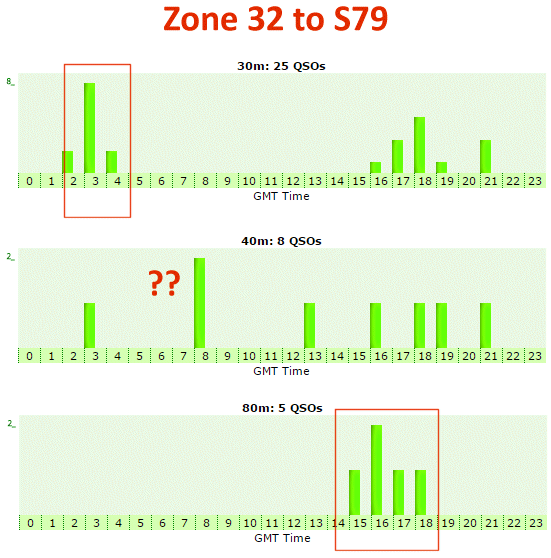
Right, how about D6 on the low bands then? When are the best times to try on 30, 40 and 80m? My propagation prediction weapon of choice is, hands down, ClubLog, so here we go:


It looks like we have a chance on 30m at 04z and on 40 and 80m at around 17-18z ... but there aren't many LF QSOs in the data set, so I'd better double-check using other, more active places near Comoros, starting with the Seychelles, a few hundred km NE but a vaguely similar Indian Ocean island DX QTH:


OK, that confirms the 30m slot around 03-04z and the 80m slot around 16-17z but 40m is all over the place with no obvious peak. Again, there aren't many QSOs in the data set so I'm fighting the noise here.

I'll try another place not too far from D6. Here's ClubLog's predix for zone 32 to Tanzania 5H:

Fascinating!  The 30m peak has flipped from 03-04 to 19z, and 80m has completely disappeared from the radar (perhaps they don't have an allocation on 80m?).  40m now peaks at 16z.

I guess the flip-flop as we cross from S7 to D6 to 5H reflects a preponderance of SP then LP QSOs.  D6 is in the middle, so either path may be open. 

My plan is to go to bed early and get up before dawn (18z here) in the hope that they will still be QRV on any of the low bands. I'll also watch the cluster in our mid-afternoons for any LF spots, although 04z is about 2 hours before our sunset so I doubt I'll even hear them on LF.

Meanwhile, I'll amuse myself while patiently listening to the white noise by checking the predix for ZL to 5R and FH, plus Juan de Nova since the recent FT5JA DXpedition probably generated a sufficiency of data points. Hmm, I guess they may even be in my log ...

Sept 22: as planned, I was up well before dawn today at 16:45z. After lighting the fire, starting the coffee machine and warming the amp, I was ready to DX by about 16:55z ... but where where D66D? I saw spots on 15m but none on any of the LF bands. Listening around the bottom end of 40m I heard a few fairly mediocre CW sigs from Europe but mostly S9 radar. On 80m, there were reasonable signals from EU and no radar ... but no hint of D66D on either band. Rats! I made a few half-hearted QSOs on 80, made another coffee, stoked the fire, and decided to check back for D66D cluster spots to see what LF frequencies they have been using. DXsummit.fi showed me a spot on 7006 kHz at 16:43z, just as I was waking up. I left a few guys still calling me on 3505 to check 7006, just in case they were still around: nothing there except S9 radar. Tuning around 40m, I found that the radar faded away from about 7025 upwards. There were lots of EU guys spotted on 40m so I guess they weren't as bothered by the radar as we are. I noticed a stale D66D spot on 7060 and checked there, just in case: there were some feint foreign voices, too weak to make out but it sounded like someone chatting, not working a pileup. Back to 80m for a while, then (at last!) D66D was spotted on 7010 by FR5DN. I returned to 40m, tuned the ATU (I'm using the 80m loop on both 80 and 40 at the moment) and turned on the K3's digital noise reduction in a vain attempt to hear them through the radar. No such luck!


On the P3 screen, I see the wave pattern of the S9 radar, a RTTY intruder on about 7016 and a few feint traces of CW around 7011, 7012 and further away. Listening patiently on/around 7010 I could maybe convince myself that there might be some DX there but mostly all I get is radar and the odd kop telling someone else to QSY.

[Aside: the Elecraft 'P3 utility' that grabbed the screenshot from the P3 has the feel of an engineering prototype. You can see the "Capture Image" button with a popup message "Copy image data from P3 to PC", but not a clue about what happens to the 'image data' once it is transferred. After clicking the button and waiting very patiently for those 34 seconds to elapse (!), there was no message telling me where I might find the file. I went on the hunt using the dreadful Windows file search function, finding nothing. So, admitting defeat, I opened the P3 help file and checked. Evidently "Capture Image" transfers the screen shot to the Windows clipboard as an uncompressed bitmap - no wonder it takes an agonizing 34 seconds to suck it out of the P3! It doesn't save the file or prompt the user to save it. To me, that's lazy programming Elecraft. Cool kit, lukewarm software.]

Checking DXcluster again, I see a few recent D66D spots on 40m, still on that frequency (roughly!):


It's now 18:13z. I've been monitoring 7010 for more or less an hour, right through our dawn at 18:02z  with the headphones on, sipping coffee, catching up with emails, re-checking the propagation predictions (above) and composing this blog update. In all that time, D66D has never risen above ESP levels - perhaps a decent signal but completely inaudible here through the radar, currently reading 10 to 20dB over S9 on the K3 S-meter. It's just not my day. 

Oh well, that's DXin.  Maybe tomorrow ...

Sept 23: ... nope, not today either. Struck out on the low bands this morning. Nobody seemed to hear me, despite getting up and on the air before dawn. 

Some of those AN400 special event stations are far too busy transmitting to bother actually listening for callers. I appreciate that DX signals like mine may be weak in Spain but they often fail to respond to EU callers that I copy just fine, way down here on the Far Side. More haste, less speed I guess.

The Scandinavian Activity Contest website is QRV today after an unfortunate outage during/after the CW contest. What a time to go QRT! I submitted my little log to the robot and was pleased to get a summary including a claimed score of 6,000 points in the low band section (80+40m only).


My 80m score was pathetic - just one solitary QSO (thanks OH9W!). I still don't know why that was. Auroral absorption is the usual culprit but the A-index was low during the contest so I guess that's not it.


The population of Oceania is about 38 million, of which Australia and New Zealand account for 28 million plus 7 million in Papua New Guinea. 

The remaining 3 million are distributed across thousands of Pacific islands. 

Compare that to the 740 million people living in Europe, a billion in the Americas, 1.1 billion in Africa and an impressive 4 billion in Asia.


Here's the population density counting only the land areas, not the oceans: otherwise Oceania would be an invisible strip on the pie chart.


The upshot is that virtually ALL our QSOs are DX.


Sept 24: D66D was spotted on 30m this morning, on several spot frequencies. I suspect some were duff spots from over-excited Europeans working them. While the Europeans were clear-as-a-bell, I couldn't hear Comoros at all, not so much as a peep. Although the SWR is OK, I'm beginning to wonder if my 30m vertical has mysteriously turned into a dummy load. It's nothing fancy, just a quarter wave of wire attached to a fibreglass fishing pole blank (aka "roach pole" or "crappy pole") mounted on a satellite dish mount on the tin-roof workshop. Perhaps I ought to put up a 30m loop and/or a rotary dipole, as comparators. The rotary dipole I used to have worked very nicely - another simple antenna, made by joining two of those fishing poles on a short tubing offcut with a bracket to mount it horizontally under the beam. I could easily put a vertical up above the beam, in the top of the stub mast, too but without the ground plane I doubt it would work as well as the one on the workshop roof - when it works, that is.

Sept 26: again D66D was spotted on 30m early this morning and again I can hear nothing except maybe the feintest whiff of an ESP-level signal way down at my noise floor. I hear callers in their pile, just not them. Oh well, I'll keep listening and hoping.

Meanwhile, Stan LZ1GC and Emil DL8JJ are QRV on the Solomon Islands, and doing a great job on 80/CW this morning. H44GC is strong here, a mere 3,700 km to our NW, and they are hearing EU callers at least as well as me, perhaps better than me. I'm impressed: my fullwave 80m loop is hard to beat! I'm getting a fair bit of QRN from a storm about half way between us, shown by the red/orange/yellow blobs on this handy map:


I think Stan & Emil are using a Spiderpole vertical on 80. They will be entering the Oceania DX Contest next weekend (the phone section), then Stan moves to H40 and will be H40GC in the CW section the following weekend.

Also on 30m this morning I was lucky to catch Jim VQ96JC with a good signal and a musical bug fist. Jim can only operate field-day style with temporary antennas and portable gear, somewhere in/near the Diego Garcia military base. It takes him a couple of hours to get to the operating site and set up each time, so his actual operating time is limited.

Thanks to Hackaday, I came across a krazy pair flying kites with wire lines in lightning storms. They are candidates for the Darwin award. You'd have thought their several close calls already on video would be a bit of a clue that they are pushing their luck, but if anything it seems to make them feel invincible.

Sept 30: came home from a few days in W6 to find this little present in my LoTW account ...


Nice!

Sept 31 (!): just after the end of the month I've been chasing a few new ones on digimodes.  Twice today I've noticed Logger32 making bizarre mistakes on the countries identified for digi QSOs.  Here's the latest:


For no obvious reason, Logger32 determined that 7Z1HL, clearly logged as such, was actually in Ethiopia, of all places. Sometimes the country L32 chooses happens to coincide with one I have recently worked, so I put it down to a little bug, but it's a    l o n g    time since I have worked Ethiopia, in other words L32 has completely lost the plot on that one. Thankfully, ClubLog spotted and told me about the obvious error in my log as soon as I uploaded the QSO info, making it easy to correct.  I wonder if this is something unique to my setup or whether you also find that L32 occasionally misidentifies the DXCC countries on digimode QSOs?  If so, please let me, and K4CY, know

04 August 2016

August 2016 - Far Side DX blog

Aug 4: over on the CDXC reflector, we've been discussing the dreadful operating heard in a recent PJ6Y pileup. Paul M0YMJ asked "I wonder what training these people have in the various offending countries during their exams. I just seems a free for all, just like shouting in a crowd. The loudest may get heard if the person bullies their way through. I must admit I do prefer CW where this happens less. But what can you do ?"

I responded first with a quip about the Brits' legendary love of queueing. Despite what you might think, behavioural studies in some situations (such as boarding aircraft) show that an appropriate degree of disorder and selfishness can actually improve the total throughput or rate, compared to a more regimented approach. 

The key phrase is 'to an appropriate degree'. It's a fine line between acceptable chaos and panic.

I fondly recall contesting on 40m at GW8GT back in the 80s when calling “JA3?” would be met by stony silence as an enormous pile of JAs ALL patiently waited their turn. Today, other JAs are more likely to break the silence, especially if it is clear that there are no JA3s calling. However, operators in large parts of Southern Europe (in particular) pay no heed to each other or total throughput, taking selfishness to new heights. The continuous callers are a pain for all concerned, especially the numpties with the over-developed amygdalas and shrunken testes who call repeatedly over the DX, deluding themselves that sending “UP UP UP YOU IDIOT UP HES WORKING SPLIT JEEZ” is the least bit helpful. 

There are several things we can do about it, starting with getting our own act in order. I sometimes get over-excited in pileups to the point of frustration and, yes, calling out of turn - for example consciously calling Phillipe FO4BM yesterday when he was calling “CQ East coast” implying the right coast of North America.

If I catch myself in time, I’ve learnt to take a break or at least back-off a notch, listen more intently, and have more respect for other callers and for the DX ops, and always to be as slick and efficient as possible in the exchange. Listening hard is essential and timing is key. Yesterday, I did call Phillipe, partly because I live on the East coast ... of North Island, New Zealand. 

Most of the burden for 'doing something about it' falls on the DX operator. Phillipe eventually heard me in the US pile and graciously thanked me for waiting (I was only calling occasionally). He was definitely ‘in charge’ and handled the pile like a pro. It’s an acquired skill though. Successful contesters and DX ops (at both ends of the pile) have lots of practice and care about this stuff enough to want to improve their own performance. There’s more to it than Nigel G3TXF’s legendary UK-ears, or the dreaded calling-by-numbers, but even split operating and locking the right VFO is beyond the capabilities of some DXers, it seems!


Aside from all that, we’re left with awareness and education (such as sharing, promoting and discussing the DX Code of Conduct*, and talking about incidents and good practices we’ve heard on air), plus training (e.g. covering operating techniques and ethics in license courses and books), plus compliance reinforcement (e.g. Phillipe’s little acknowledgement to me, a gentle reminder to the rest of the pile) and enforcement (e.g. warning and if necessary blacklisting persistent offenders). 

Many of us feel that’s not enough. We often hear the plaintive but vacuous “Something ought to be done!”. I suspect things would quickly descend [further] into utter chaos if we stopped doing what we do already, but I’m always willing to listen to new ideas or to refine the approach … so if you have suggestions, let’s talk 'em over and maybe try 'em out. 

* By the way, the DX Code didn’t ‘just happen’ all by itself. It took effort and collaboration by a bunch of experienced hams over a couple of years to draft and refine the code, publish it, and promote it as widely as we could through assorted mail-outs, societies, clubs, reflectors and more. It was something we could do, and so we did. We know it is not the Ultimate Solution. Nevertheless, it is gratifying to see the logo appearing on so many DXpedition, club and individual ham websites: the approach seems to have resonated with the ham community, which I reckon indicates its success. The job’s never done though. Maybe the Code could do with a refresh/update (e.g. covering the issue of remote users operating within the license and correctly identifying themselves, and QSL practices such as charging for LoTW confirmations) and perhaps additional promotion?

Aug 5: the CDXC discussion continues. Today we've been talking about options for handling the rude out-of-turn continuous callers, particularly the selfish, ignorant idiots who try to bully their way into the DX log. Tom GM4FDM said he ignores them for a while in the hope they'll stop but if not he singles them out for a special message: "You have been constantly been calling me for some time. I have asked you to stop. You operating skill is very bad. This is not a QSO and will not be logged. If you keep calling me you will never be in my log." I argued that giving their call means it IS a QSO, but not logging it is a reasonable response. As Tom says, it 'shuts them up, sends a message to other listeners in the pile and, if repeated often enough, gets the word out.'

My pal Roger G3SXW told me about taking umbridge at the Italian bullies, specifically, on one of his DXpeditions, to the point that he decided not to work any more Italians. He chose not to announce his policy: he simply ignored Italian callers, working everyone else in the pile until the only ones left were the Italians, still calling but by now getting desperate ... which was the point really. Their tactics (or rather the antics of the Italian bullies) backfired on them.

The bigger point is that the DX op can and should take charge of the situation, doing something positive about it. (Briefly) explaining or lecturing to both the offender and the rest of the pile is, I feel, an important part of the response, stating explicitly that certain on-air behaviours are simply unacceptable. It validates and supports the behaviour of the ones waiting patiently in the wings.

Sometimes in my little pileups, if the aggravation gets too much, I take a break. Just before I go, I usually send a parting message, something along the lines of “QRT DUE TO EU QRM”. It makes me smile to hear people remaining in the pileup repeating or explaining it to the IQ-zeroes who are still calling me. The message spreads. Job done.

I also call-out bullies in my QSOs by mentioning “SRI QRM FROM ITALY” or whatever, letting the bully know that I hear them just fine but I am refusing to acknowledge them or cave-in and complete a QSO with them. I studiously avoid giving the bully's full callsign, though. I refuse to give them the satisfaction. Occasionally, I’ve had a bully take the hint and shut up, and on rare occasions we may later complete a civil QSO in which a few have been knowh to apologise for causing QRM (albeit usually with some lame excuse) which also makes me smile: that’s a QSL as far as I’m concerned, a successful education and we’re friends again. Tough love you could call it.

Another more assertive approach is to wind-up a persistent bully by deliberately busting his call, and completing a fake, unlogged QSO with the busted call. That usually shuts the bully up too (which is, usually, the primary objective), leaving him unsure whether I have logged him or not. For kicks, I may tell the pile what I am doing, perhaps making valid QSOs in parallel while the bully is still desperately trying to correct me, deliberately doubling with him so he doesn't hear what's going on. It knocks the wind out of his sails anyway, and amuses me and the pile.

Yet another approach is far more common, especially on CW: I simply QSY my receive frequency and narrow the filters to dodge the bully. Again, I may give the new split instructions while the bully is transmitting so he misses out. I may even play the partials/busted callsign game with him, sending the occasional letter or two from his callsign to keep him busy transmitting on his original frequency (right at the edge of my filtering) while simultaneously working the pile somewhere else. The idea is partly to drive him nuts, but mostly to complete more QSOs with The Deserving.

Perhaps that's what they mean when they say DXing is fun! 

Aug 6: when I'm calling a DX station, I’ve had the occasional “helper” – someone in the pile who hears me plaintively calling the DX, and tells the DX I am calling. If they say “LSN ZL” or whatever, that’s fine by me, but I’m not keen on “ZL2IFB CLG”. Worse still are the strong “helpers” who send just my callsign on my behalf: the DX then sends them a report expecting to hear the same strong signal from them, not my puny tiddler of a signal which leads to confusion and delays. In the end, regardless of the outcome, I’m unhappy about the assisted QSO and often unsure whether I was actually logged. I realise the “helpers” mean well but I could do without that kind of help, thank you! 

In contrast this morning Nick ZL1IU spotted Cyril FR4NT calling CQ VK/ZL on 80/SSB. I was struggling to hear Cyril through strong radar QRM but I heard enough to risk a few calls, while simultaneously trying to tune my loop to the top end of the band without tripping the amp. Cyril didn’t hear me, so after a few calls Nick asked me if I wanted him to alert him. Nice of him to offer! I declined and decided to wait a few mins until sunrise in the hope the path would improve but Cyril went QRT about 10 mins before my SR. At the end, Nick said Cyril was ‘coming up to 59’: I’d have given him 35 here, poor copy. That's the difference between a simple wire loop in the trees and a 4-square with over 300 radials!


Aug 11: my hunt for DXCCs on every band this year has slowed to a crawl, almost to a stop. I'm paying the price now for Hoovering-up every scrap of DX earlier in the year, and suffering the usual poor conditions at this time of year. There is a glimmer of hope though: a planned activation of YV0 Aves Island in the Carribbean North of Venezuela in the first week or so of September. It will be an all time new one for me, so I'm planning and preparing for at least one QSO, hopefully. 

First task was to Google for any more information other than the brief announcements on DXnews and DX-world. All Mr Google found for me was a couple of snarky comments about previous trips that didn't come off due (it seems) to lack of permission from the Venezuelan military authorities who evidently control the island. The newly announced trip doesn't appear to have a website as yet, but maybe that's because negotiations are at a delicate stage and the arrangements aren't firm - fair enough. We all witnessed the recent cancellation of a planned DXpedition to P5 due to premature disclosure of the plans (although I picked up more than just a hint of sour grapes from the DXpedition leader who had been refused a P5 visa and - understandably - pulled the rug). Anyway, that's not the end of it.

My next step was to look up propagation predictions for YV0 from ZL in September. Just a few years ago, my first choice would have been VOAcap or another prediction program that claims to model the ionosphere. My experience has been distinctly patchy with those theoretical predictions, so now I go straight to ClubLog. ClubLog shows theoretical predictions too, but I'm much more convinced by the historical records of actual QSOs between the stated end points. Given that there are so few YV0-ZL QSOs in ClubLog (as yet!), it's easy to choose YV or any of the nearby islands in that part of the Southern end of the Carribbean to see both the predictions (in orange) and when ZLs have actually contacted them (in green), in September, on the bands that are most likely to be open to that part of the world today:


The graphs are 'clear-as' (as we Kiwis say), with obvious peaks at 3-4-5-6z on 17-20-30-40m. So guess where I will be loitering come August 31/Sept 1?

And that's still not the last of my prep. This afternoon, I added YV to the DXcluster alerting filters in Logger32, giving me the chance to check out the actual propagation to that part of the world in the run-up to the DXpedition. Maybe there are other openings that are worth exploiting when they come on? We'll see how it turns out over the next 3 weeks or so.

Aug 22: nothing much happening on the air of late. Chasing CY9A and a few YV stations with mixed results so far. Received LoTW confirmations from EP2A. Selling my IC7600 on TradeMe having bought a second K3 instead ... and I need to get going on antenna work and the SO2R setup.

Aug 24: last evening I patiently monitored 80/CW for CY9A from before our sunset and again before their sunrise, plus some of the time inbetween. I don't think I heard anything of them: there was a very weak CW signal on their last-spotted frequency but I think it was just someone sending dahs, perhaps a stuck paddle. This morning, I heard and called them for some while on 30m without success. They were quite weak and busy working Europeans. At lunchtime I noticed a spot on 15m and decided to have a listen. I clicked the spot, turned the beam and heard them quite strong, working someone just at the edge of my CW filter. I spun the transmit VFO in that general direction and clicked the memory button to send my call, once, noticing a high SWR on the little 2 ele beam hence about 500 watts out of the amp instead of the usual 800 or so. Imagine my surprise when they came straight back with my complete call and a report. In just a few seconds later we completed a QSO  :-)

This evening, I spent some time on 80/CW at dusk as usual, with breaks to feed two lambs and cook dinner. No sign of CY9A - I guess they were sleeping. After dinner, I checked the cluster and tuned around the bottom of 80, still nothing so I decided to watch TV ... but I left the rig and amp running just in case. In front of the TV, I called up DXsummit.fi on a laptop to keep an eye on 80, and a few minutes later there they were: CY9A spotted on 3523 listening up 1. I nipped into the shack, tuned to 3523 and listened. I heard "CQ CY9A CY9A" at a reasonable strength, but there was no "UP" so I made a snap decision, clicked a button triggering a +1 split macro, and sent my call once. I heard another ZL calling but they came straight back to me with "ZL2IFB 5NN". I sent them 5NN and logged the QSO.  Thanks very much. Job done! That's DXCC #220 on 80.

04 July 2016

July 2016

July 4: I and other Kiwi DXers have been chasing a group of DXers from A6 (United Arab Emirates) currently in the Seychelles. S79V has been quite active and spotted on bands that 'should' be open to ZL at the time, but their signals have been weak or very weak here. 

Yesterday I caught them on 40/CW - well almost. The path was marginal so we needed a few repeats. Some of the more impatient Europeans in the pileup just wouldn't give us the chance to complete our QSO in peace. The S79V op was good and patient enough to keep on trying with me but the callers didn't let up, until eventually we parted company. I'm not sure who he logged - looks like it wasn't ZL2iFB though. That's a shame: it would have been a new DXCC for me on 40m. Not to worry, I got them on 20m via the long path this afternoon, while poor old Mike who has never worked S79 has barely even heard them so far. Good to their word, they have uploaded to LoTW already.


July 7: over the past day or three, I've been sorting out a shack PC belonging to my pal Lee ZL2AL (SK). My main objective was to retrieve Lee's log in order to be able to respond properly to his incoming QSL cards, so the first job was to find his log. I found several ... but I think I know which is the main one. I will have to check that later and maybe combine it with the others, but thanks to the ADIF format, it is quite straightforward. 

Next job was to decide what to do with the PC. I've been selling off Lee's junk pile on behalf of his family gradually over the past 3 months (I'm not that slow: Lee had a lot of stuff!). I'd like to sell his PC but I'm reluctant to release the hard drive in case there's anything personal on there (it will go back to the family). A little old PC without the hard drive is hardly worth selling though. Yesterday I dug out a spare disk drive from my junk pile to replace it. Being an information security pro by day meant I had to erase the contents properly, a job which took several hours overnight using DBAN Boot-n-Nuke.

Today I downloaded the latest release of Ubuntu, made an installation DVD, and installed it. Well, to be honest I first installed an old release of Ubuntu and soon discovered that it wouldn't recognize the Ethernet port on Lee's PC. The new release works fine. Installing CQRlog was next, another painless job, and there it is: a decent good-as-new PC, ready to grace the next ham shack. 

Another job today was to test a high voltage transformer that has been sulking in a corner of the workshop for a few years. I bought it with the intention of forming the plate supply for a GS35 amp I'll be building one day ... but at a back-breaking 83 kg, it was simply impracticable so now I'm selling it to someone who will make good use of it. Rather than just ship it off and hope for the best, I thought I'd better check it first, but how? It is rated for 2,500V output and several kVA, and has to be treated with respect. A continuity check of the windings was an easy start, then I used a little wall-wart transformer to squirt about 16 V AC into the 230 V primary, generating about 160 V on the secondary. So far so good! Finally, the smoke test: I rigged up a mains cable through a 3 amp fuse, stood well back and gingerly switched on. No bang, no smoke, no worries! It doesn't even hum (off-load anyway)! Although I don't presently have an AC voltmeter man-enough to check the HV output, I'm happy that it is working. Job done. 


July 9: I'm chuffed with my latest purchase - a second Elecraft K3 transceiver plus a P3 panadapter. The P3 needs a good clean and I must study the instructions to learn how to drive it properly, but it works just fine ...


That's a clip of XW4XR working a RTTY pileup split: we can easily see where the stations are on the band, including someone who pops up in between the DX and pile towards the end of the clip.

I'm edging ever closer to a competitive SO2R (Single Op 2 Radio) setup. Still a few things to sort out on the station, particularly the local and remote antenna switching and the ergonomics. Although the colourful little LCD display on the P3 is usable (and nothing like as blurry in real life as in that dodgy home vid!), a full-sized monitor would be better. Trouble is I'm running out of desk space with 2 widescreen displays already in use. Time for a re-think: how can I squeeze in another display? Google Glasses maybe? Or suspend it from the ceiling on number 8 wires? 

On top of that, the HF quad construction project has not progressed for several months. Without a decent HF beam, the rest is moot.

Meanwhile, I now have a surplus Icom IC7600 and a few other bits-n-pieces to sell in order to replenish the bank balance. My impulse purchase on TradeMe, which to me was the bargain of the century, was duly noted by The Boss who seems to think one radio is more than enough for anyone. So much for my cunning plan to slip the new gear quietly into place in the shack while The Boss was out: she had to collect the box from a lazy courier in Napier (cheers Mainfreight) which rather gave the game away.

Another job on the to-do list is to stick a load of endorsement stickers on my DXCC certificates - well maybe. I'm not that desperate to brag to passing shack visitors although it would be quite nice to see the outcome of all that effort chasing DX. The envelope of stickers has been collecting dust for a few years so far, awaiting the mythical Round Tuit.

July 10: although I joined the committee for the Oceania DX Contest at the end of last year to help with the marketing and promotion of the event, I haven't had the time or energy to get going on it, other than drafting a perennial marketing plan for the contest at Christmas. With just 3 months to go until this year's contest, it was high time to pull my finger out and do my job. 


The contest website had been laboriously hand-carved in HTML by Geoff ZL3GA and was desperately in need of a thorough rewrite ... so this weekend I did. The sexy new Oceania DX Contest website is now live, giving a clean, modern look to the contest and, hopefully, even more interest in the event from the global ham community.


I've opted for a minimalist mostly-white site design for now with a very simple top-row seven-button menu plus a few subsidiary pages on fly-out buttons. Provided the profusion of bugs in NetObjectsFusion doesn't cause too many problems, the site should be much easier to maintain and update going forward. 

There is plenty of scope to add more photos and other stuff in due course, including some of the choice soapbox comments from past entrants. So much to do, so little time ...

July 11: I made a few more changes to the OCDX contest website today, including a countdown timer and some better photos.

I updated the P3 firmware too, which meant loading the P3 Utility first so now I can grab P3 screenshots like this:


I was idly monitoring 30m this lunchtime after a Carribbean station had been spotted. I called him for a while and although he didn't hear me, SP7ER evidently did. Stefan was weak but just strong enough on QSB peaks to catch his call on the 3rd attempt and we completed a quick QSO. 30m is an interesting band!  On the left of the P3 display you can see the dual peaks of the German commercial RTTY station broadcasting weather info 24x7 just above 10100 kHz, a handy beacon. It would be nice to know what power and antenna they use. At that time (01:30 UTC) they were about S6 on the K3 meter on a simple quarter wave wire vertical supported on a fishing rod, albeit with a good ground plane, the tin roof of my workshop.

A nice QSL card arrived direct from EP2A today and it's mostly good news:


Although ClubLog had earlier rejected my first QSO with them, they confirmed it (hence the orange background in Logger32). However our final two QSOs on 17/CW were not confirmed. Personally, I think their operator is to blame. When I first called in on April 25th, he told me "QSO" (as in "You are already in the log") so I duly checked my log. Sure I had worked them already but not on 17/CW ... so a few minutes later I called again and that time we completed a QSO in the normal way - or so I thought. Looks like the op was just trying to get rid of me and didn't log either QSO. This unfortunate situation illustrates why we should log every QSO, even those we think are duplicates. I guess they probably worked another ZL before on 17/CW and busted his call, logging him as ZL2iFB. Conceivably, I worked them before but neglected to log it, or busted their call, or Logger32 failed to record it properly (unlikely but possible). Either way, EP2A was not in my log prior to 25th April - in fact those QSOs with EP2A remain my only Iran QSOs on 17/CW, now destined to remain unconfirmed forever I guess. C'est la vie.

July 12: 20m burst into life this morning - well there was a nice little bit of DX about anyway: several Caribbean stations and a few Europeans coming in over the long path via central/South America. As the Caribbean guys were beaming East to work the Europeans, we were off the back of their beams which made it a bit of a struggle to get through to them. The LP Europeans were quite strong. I must remember to listen again tomorrow morning.

July 18: I've finally figured out how to get Logger32 to send mode-specific commands to the K3 when I click DX spots, split-spots specifically. I prefer to listen in both ears to the DX station working split on the subreceiver/VFO B, checking the pileup in my left ear only and transmitting on VFO A. On CW, I normally narrow the bandwidth on the subreceiver to 500 Hz but leave the main receiver wide open at 2.7 kHz. The macro for that works fine on CW. On SSB however, the subreceiver's 500 Hz bandwidth setting in the macro was becoming a pain ... so in place of the original bandwidth command in the "Macros to apply DX Spot split information" window (replacing the command string and the associated semicolon, that is), I now have #ModeModifier# which complete string gets substituted at run time for the appropriate mode-specific commands taken from the "Comma separated mode specific commands" panel i.e. CW=BW0050;, SSB=BW0270;  I guess I might want to mess around with other mode-dependent settings such as the AGC speed and DSP, but for now bandwidth is enough.

The latest VK0EK Heard Island DXpedition newsletter neatly assembles pictures covering the scientific and radio activities undertaken - a notably wide range of things when you see them all laid out. They must have been really busy!

July 19: my QSL arrived today from the recent FT4JA Juan de Nova DXpedition:


The smart full-colour card arrived in a special envelope with unique printed Juan de Nova stamps, despatched via the TAAF (French military) into the normal postal system.


Nice!

July 20: in place of a thousand words ...


Thanks to CQ Magazine and K9EL John who runs the brilliant year-long CQ DX Marathon, plus the nice people of the South Florida DX Association who kindly sponsor the shiny plaque.  

"Bramble" says hi too. She's helping me sniff out the DX this month.

July 21: some disappointing news came today, but in the nicest possible way.  A month ago I was excited to catch SV2RSG on 30m CW.  The call belongs to Father Iakovos, a monk on Mount Athos.  I duly sent off my QSL direct to his QSL manager George SV1RP. George has been patiently teaching Iakovos the radio theory to pass the license exam and get on the air.  Well today I received my QSL card back with this hand-written letter from George:


Good to his word, George returned all bar $1 of the money I sent him, plus my card and envelope. I feel cheated by whoever it was that pirated the call but at the same time uplifted by George's amateur spirit. We know now that Father Iakovos should be QRV soon from Mount Athos, hopefully for the rest of July and August, so I shall be keeping a close eye on the cluster.

July 23: another frustrating experience this morning at about 8am (20z). Yesterday it was a ZD8, today a ZD7 working Europeans on 20m SSB at a QSO or two per minute. I presume the ZDs were both beaming North, giving and receiving 10-over-S9 reports from the UK. Their signals were weak but readable down here via the long path, over the North pole, but try as I might I couldn't raise either of them. I spotted them both, partly to let them know their signals were making it all the say to the Far Side and partly to drum up some help from other ZLs who might have better signals, timing or luck than me. FAIL! Oh well, that's the fun of DXing.

July 25: the DX frustration continues. This morning before dawn I was calling OJ0W on 40/CW in vain for more than 20 minutes. He was weak, again, working EU mostly but for a while he called CQ DX. He was listening 0-4 kHz up, working the odd EU caller simplex which, of course, encourages everyone else to call him simplex too (doh!). When he started with the CQ DX, he didn't say up and it wasn't clear where he was listening, so I tried up 4, 3, 2, 1 and then out of sheer frustration simplex. Not a hint of a contact anyway. 

I then moved down to 80/CW to call an ES and an LZ station. The Estonian was just giving his call sporadically as if he was calling someone else, except for the occasional CQ thrown in at random. He either didn't hear me at all or didn't respond in any way. The Bulgarian was CQing conventionally and he heard something of me, at least he stopped calling to listen to me, twice, then sent "NIL" and recommenced CQing. I must have been just too weak to copy. Fair enough, LF conditions weren't up to it today. A later spot referred to an aurora which implies high RF absorption.

YI3WHR was once more spotted on 20m this morning, and as usual he was impossibly weak. I guess the damp noodle he is using as an antenna needs to be higher, or better matched so a few more of his milliwatts make it up the spout. I've been chasing him and another YI station on SSB and occasionally PSK for about 2 months now, and prior to that a YI pirate (who, ironically, was much stronger and heard me just fine!). If only they would learn CW, we might have a chance!

July 28: as usual this morning OJ0W was spotted but inaudible on 40m, then QSYd to 30m. For once I heard him OK, working JA's simplex. The JAs were much stronger than him, clambering all over the frequency with LP echoes smearing their signals to add to the challenge (full marks to JF1IRW for persisting and completing despite QRM from other JAs).  Ten minutes or so later, having worked about a dozen JAs, he just disappeared, leaving us calling plaintively into the void. It's as if he's deliberately avoiding me! At one point earlier his signal took a sharp dive into the noise - possibly an intermittent TX/feeder/antenna fault his end? That might explain why he has been inaudible most of the time.