Sept 1: does it help the situation in the slightest by sending, right on top of VP6K on 30m RTTY: "SPLIT UP SPLIT UP SPLIT UP SPLIT UP UP UP SPLIT UP UP UP"? That kind of nonsense is par for the course when the EU zoo is in full flood. SOME European DXers evidently have more watts than sense. Small wonder DXpeditioners increasingly dread EU openings.
Sept 7: this afternoon I came across what I initially thought was a W1AW QST news broadcast in CW on 18100 kHz ... but not on the normal 17m QST frequency and without the usual repeated IDs every few minutes. It turned out to be VE7FWJ/B sending CW practice text (a physics article about gravity) at 15 wpm, with single IDs every 6 or 7 minutes. Good copy in ZL at 03z and near-perfect CW, presumably computer generated. Odd that the beacon is not listed on any of the beacon lists I've seen, and VE7FWJ doesn't maintain a QRZ.com page, or indeed any web page that I can find. The broadcast was running for at least the 15 or 20 minutes that I heard, and ended at about 0312z with "DE VE7FWJ/B 15 W PM 20 WATTS 73".
Sept 8: having yesterday watched a video comparing an Elecraft K3 against a Drake 2B, today I read a blog piece about the comparability of modern cameras ... and spotted the obvious parallel. Modern amateur transceivers - all of them - are highly capable devices with very similar performance, more than barely adequate for almost everything we want to do. We haven't yet reached the physical limits in amateur equipment, on the whole, but our capacity to communicate is constrained not by the radio technology so much as by the ionosphere and increasing wideband noise from a gazillion computers, switch-mode power supplies and other nasties. Even better radios won't make much difference in practice, and yet we're suckers for everything new and shiny.
Given such similar performance characteristics, an operator's choice of one radio over another is mostly down to personal preference and ergonomics. Oh and branding. And price.
Sept 10: I've been a bit distracted from the radio this week, thanks to a generous free offer from Embarcadero. They released the 'starter edition' of Delphi/RAD Studio and provided a week-long boot camp - a series of webinars (Monday Tuesday Wednesday Thursday Friday) plus a free book explaining how to use it. I've been longing to get back into programming, having cut my teeth on BASIC and Turbo Pascal back in the 80's. Things have moved on a bit since then, with lots of new terms and concepts to discover - terms such as IDE, VCL, Firemonkey and RX. This week I've written my first program in many years, dragging things around on the screen instead of writing lines of code. I'm looking forward to writing some simple utilities for manipulating ADIF files, nothing too fancy though, just baby steps for me. Although the free 'starter edition' can only generate Windows 32 bit programs, I don't need 64 bit, MacOS, Linux or Android versions so it's perfect for my needs at this point. Thanks Embarcadero!
Thanks also to A Beginner's Guide to Delphi Programming: it doesn't exactly match the IDE version I'm using, but it's close enough for my purposes. I just need a leg-up to get going.
Sept 12: 15m opened to Europe long path this morning, enabling me to catch a few DXCCs in the WAE contest. That little run lifted me to a more respectable 6th place in this month's CDXC HF Challenge:

The HF Challenge was bound to be hard this year given the rapidly evaporating sunspots - not as hard as I thought though. It's funny how a supposedly dead band can spring to life during a contest.
Sept 16: finally! Today I passed my pal Lionel G5LP in the CDXC DX Marathon Challenge CW table. We've been neck-n-neck all year, chasing the same DX. Every time I caught him up, Lionel swiftly pulled ahead ... except today I took the lead by just 1 DXCC. I'm quite sure Lionel will at chalk up at least 1 more DXCC in his next update, and so the game continues. It's great fun. Lionel lives in a suburban house with a small garden, surrounded by other houses and by all of Europe, while I live in rural NZ with a few acres of space, no neighbours in sight and little but the Pacific Ocean for thousands of kilometres ... and yet despite the disparities we are very evenly matched in the Challenge.
Sept 18: I'm still grinning today about a remarkable DX QSO last evening on 80m. TO5FP was spotted on 80/RTTY about 10 minutes before our sunset. I was already QRV on the band, nosing around to see if there might be any Scandinavians to work tomorrow evening in the Scandinavian Activity Contest (there weren't!). So I clicked the spot, started up MMVARI through Logger32, clicked the spot again to get back to the spotted frequency, and saw a weak tramline trace. A minute or so later I had the DX signal on VFO B centred on the GRITTY markers and I found their pileup a bit up the band on VFO A. For the next few minutes I called them, with a few short breaks to find a suitable hole in the pileup and shift away from ZL1AIX's massive signal. I settled just above the upper edge of the pile - easy to see on the P3 screen - and, as if by magic, they came back - firstly ZL2? then ZL2I? then ZL2IF (I think that was the sequence). I sent my call several more times but by this time the ravenous horde from Europe were seething over us both. Last thing I saw from them was TU ZL2IFB as I headed off for a celebratory glass of red, still not quite believing it. St Pierre et Miquelon on RTTY, on 80m!
Today I checked their log on ClubLog, and there it is - a green tick on 80/RTTY. Fantastic!

[Updated Sept 26th. I'm delighted to have filled those 6 slots, especially the 80m one.]
Sept 19: I heard V633ZH working Japan, in Japanese, on 15m this evening. My Japanese is nonexistent, but I’m pretty sure I heard one of his contacts mention “New Zealand” and sure enough he put the Japanese on hold to work me. The Japanese, meanwhile, patiently listened in as we completed a pleasant QSO and cheerfully signed off. Such a refreshing change from the EU zoo.
Sept 20: lots of AN400+1 letter stations QRV today - some sort of Spanish festival maybe? Their QRZ pages (all of them) refer to a "diploma and award commemorating the IV centenary of the death of Cervantes" with pictures of the awards but next to no information about Cervantes. There's a link to a website for "rules, log online and ranking" where, in amongst yet more promotion of the awards and a table showing their activity across the HF bands, we find these few brief words of explanation:
I'll probably work a few of them over the next few weeks. Maybe I'll get the chance to ask them - on air - what all the fuss is about. I wonder if any of the ops will be able to tell me anything about Cervantes, or will they be too busy working the pile?
After working 40 and 80m in the SAC CW event on Sunday, I went to the SAC website to enter my log, only to discover their server is down. It says, in Swedish and then in English:
Sept 21: this evening a cunning plan came together like a dream. For a few days now I've been stalking D66D on Comoros, looking to fill several slots on my DXCC table, especially on CW. I only had one CW QSO confirmed (D64K on 15m in 2012, confirmed on LoTW) and don't yet have a QSL card from D6. I caught D66D on 15m CW (again!) soon after they started but I've been struggling on the other bands. We made it on 17m the other day but, although they have been spotted several times, they have been far too weak for me on 20m ... until this evening. A couple of days back, a Kiwi DXer pal from South Island said he had worked them on 20m SP with good signals in our mid-morning: try as I might over the last 3 days, I couldn't hear anything from them on SP at that time, so I resolved to try the evening 20m LP opening instead. At that time, they are usually working late-night DXers from the states, and early-risers from EU, both SP, so their pileups are small which gives us a chance on the LP. This evening, I was literally in the process of turning the beam and tuning up on 20m as planned when they were spotted, right on cue, on 14025. I clicked the spot, clicked a macro to split up 1, listened for them and within seconds clicked the CW memory button to send my call. They came right back to me, albeit with a partial. I clicked the button to send my call again, they copied it and sent me a report, and I sent them their report and logged it. The entire exchange was over in about 20 seconds, plus 2 or 3 days preparing for it, plus several years building the station, and decades honing my skills!
Right, how about D6 on the low bands then? When are the best times to try on 30, 40 and 80m? My propagation prediction weapon of choice is, hands down, ClubLog, so here we go:

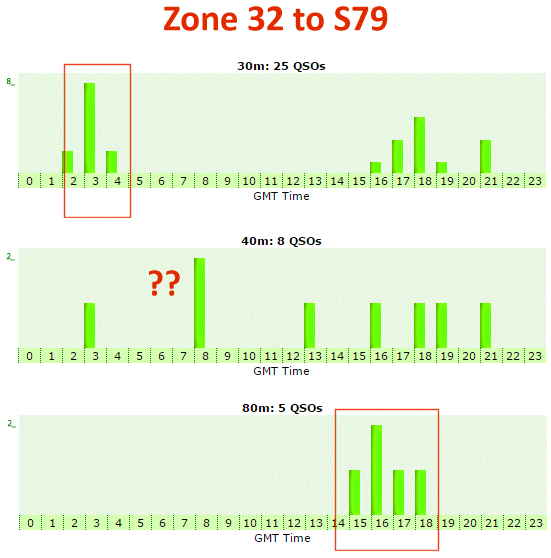
OK, that confirms the 30m slot around 03-04z and the 80m slot around 16-17z but 40m is all over the place with no obvious peak. Again, there aren't many QSOs in the data set so I'm fighting the noise here.
I'll try another place not too far from D6. Here's ClubLog's predix for zone 32 to Tanzania 5H:

Fascinating! The 30m peak has flipped from 03-04 to 19z, and 80m has completely disappeared from the radar (perhaps they don't have an allocation on 80m?). 40m now peaks at 16z.
I guess the flip-flop as we cross from S7 to D6 to 5H reflects a preponderance of SP then LP QSOs. D6 is in the middle, so either path may be open.
My plan is to go to bed early and get up before dawn (18z here) in the hope that they will still be QRV on any of the low bands. I'll also watch the cluster in our mid-afternoons for any LF spots, although 04z is about 2 hours before our sunset so I doubt I'll even hear them on LF.
Meanwhile, I'll amuse myself while patiently listening to the white noise by checking the predix for ZL to 5R and FH, plus Juan de Nova since the recent FT5JA DXpedition probably generated a sufficiency of data points. Hmm, I guess they may even be in my log ...
Sept 22: as planned, I was up well before dawn today at 16:45z. After lighting the fire, starting the coffee machine and warming the amp, I was ready to DX by about 16:55z ... but where where D66D? I saw spots on 15m but none on any of the LF bands. Listening around the bottom end of 40m I heard a few fairly mediocre CW sigs from Europe but mostly S9 radar. On 80m, there were reasonable signals from EU and no radar ... but no hint of D66D on either band. Rats! I made a few half-hearted QSOs on 80, made another coffee, stoked the fire, and decided to check back for D66D cluster spots to see what LF frequencies they have been using. DXsummit.fi showed me a spot on 7006 kHz at 16:43z, just as I was waking up. I left a few guys still calling me on 3505 to check 7006, just in case they were still around: nothing there except S9 radar. Tuning around 40m, I found that the radar faded away from about 7025 upwards. There were lots of EU guys spotted on 40m so I guess they weren't as bothered by the radar as we are. I noticed a stale D66D spot on 7060 and checked there, just in case: there were some feint foreign voices, too weak to make out but it sounded like someone chatting, not working a pileup. Back to 80m for a while, then (at last!) D66D was spotted on 7010 by FR5DN. I returned to 40m, tuned the ATU (I'm using the 80m loop on both 80 and 40 at the moment) and turned on the K3's digital noise reduction in a vain attempt to hear them through the radar. No such luck!

On the P3 screen, I see the wave pattern of the S9 radar, a RTTY intruder on about 7016 and a few feint traces of CW around 7011, 7012 and further away. Listening patiently on/around 7010 I could maybe convince myself that there might be some DX there but mostly all I get is radar and the odd kop telling someone else to QSY.
[Aside: the Elecraft 'P3 utility' that grabbed the screenshot from the P3 has the feel of an engineering prototype. You can see the "Capture Image" button with a popup message "Copy image data from P3 to PC", but not a clue about what happens to the 'image data' once it is transferred. After clicking the button and waiting very patiently for those 34 seconds to elapse (!), there was no message telling me where I might find the file. I went on the hunt using the dreadful Windows file search function, finding nothing. So, admitting defeat, I opened the P3 help file and checked. Evidently "Capture Image" transfers the screen shot to the Windows clipboard as an uncompressed bitmap - no wonder it takes an agonizing 34 seconds to suck it out of the P3! It doesn't save the file or prompt the user to save it. To me, that's lazy programming Elecraft. Cool kit, lukewarm software.]
Checking DXcluster again, I see a few recent D66D spots on 40m, still on that frequency (roughly!):

It's now 18:13z. I've been monitoring 7010 for more or less an hour, right through our dawn at 18:02z with the headphones on, sipping coffee, catching up with emails, re-checking the propagation predictions (above) and composing this blog update. In all that time, D66D has never risen above ESP levels - perhaps a decent signal but completely inaudible here through the radar, currently reading 10 to 20dB over S9 on the K3 S-meter. It's just not my day.
Oh well, that's DXin. Maybe tomorrow ...
Sept 23: ... nope, not today either. Struck out on the low bands this morning. Nobody seemed to hear me, despite getting up and on the air before dawn.
Some of those AN400 special event stations are far too busy transmitting to bother actually listening for callers. I appreciate that DX signals like mine may be weak in Spain but they often fail to respond to EU callers that I copy just fine, way down here on the Far Side. More haste, less speed I guess.
The Scandinavian Activity Contest website is QRV today after an unfortunate outage during/after the CW contest. What a time to go QRT! I submitted my little log to the robot and was pleased to get a summary including a claimed score of 6,000 points in the low band section (80+40m only).

My 80m score was pathetic - just one solitary QSO (thanks OH9W!). I still don't know why that was. Auroral absorption is the usual culprit but the A-index was low during the contest so I guess that's not it.

The population of Oceania is about 38 million, of which Australia and New Zealand account for 28 million plus 7 million in Papua New Guinea.

Sept 4: well before sunset this evening I heard an unusual callsign on 80/CW: 5E3A is, apparently, a special event station in Morocco operated by EA1ACP, EA5HPX, EA7FTR and EB7DX, according to DX-World that is. Their QRZ page says hardly anything. Anyway, 5E3A was repeatedly calling CQ, and I was repeatedly calling him for maybe 10 minutes or so. His signal was clearly readable and a reasonable strength but there was no hint of him hearing me. Fair enough, it was still full daylight here - about an hour before my sunset and, as I discovered thanks to Logger32's status line, about an hour before his sunrise. So I quit calling, spotted him and just listened for a while, hoping that he was going to stay on the band until dawn.
Still listening some 10 minutes later I realised I was hearing at least some of the Europeans calling him better than him. He was calling CQ on a short loop leaving only a couple of seconds between CQs. I guessed either he wasn't listening properly (perhaps sleep-deprived and caffeine deficient) or maybe he had high local noise.
I called him again and this time he responded, tentatively at first with DL? then DL2?, then IFB?, then a report ... then DL2iFB and a report, then TU QRZ? Each time I sent my call, once with an extra couple of ZLs for good measure (ZL ZL ZL2iFB) but, quite deliberately, no report since he hadn't yet got my callsign right. On the point of giving up, I called him once more with ZL2iFB ZL2iFB and at last he responded with my full call and a report. I sent him a report and logged the QSO - job done. He immediately returned to the short-loop CQs, still seemingly oblivious to his EU callers.
Sept 7: this afternoon I came across what I initially thought was a W1AW QST news broadcast in CW on 18100 kHz ... but not on the normal 17m QST frequency and without the usual repeated IDs every few minutes. It turned out to be VE7FWJ/B sending CW practice text (a physics article about gravity) at 15 wpm, with single IDs every 6 or 7 minutes. Good copy in ZL at 03z and near-perfect CW, presumably computer generated. Odd that the beacon is not listed on any of the beacon lists I've seen, and VE7FWJ doesn't maintain a QRZ.com page, or indeed any web page that I can find. The broadcast was running for at least the 15 or 20 minutes that I heard, and ended at about 0312z with "DE VE7FWJ/B 15 W PM 20 WATTS 73".
Sept 8: having yesterday watched a video comparing an Elecraft K3 against a Drake 2B, today I read a blog piece about the comparability of modern cameras ... and spotted the obvious parallel. Modern amateur transceivers - all of them - are highly capable devices with very similar performance, more than barely adequate for almost everything we want to do. We haven't yet reached the physical limits in amateur equipment, on the whole, but our capacity to communicate is constrained not by the radio technology so much as by the ionosphere and increasing wideband noise from a gazillion computers, switch-mode power supplies and other nasties. Even better radios won't make much difference in practice, and yet we're suckers for everything new and shiny.
Given such similar performance characteristics, an operator's choice of one radio over another is mostly down to personal preference and ergonomics. Oh and branding. And price.
Sept 10: I've been a bit distracted from the radio this week, thanks to a generous free offer from Embarcadero. They released the 'starter edition' of Delphi/RAD Studio and provided a week-long boot camp - a series of webinars (Monday Tuesday Wednesday Thursday Friday) plus a free book explaining how to use it. I've been longing to get back into programming, having cut my teeth on BASIC and Turbo Pascal back in the 80's. Things have moved on a bit since then, with lots of new terms and concepts to discover - terms such as IDE, VCL, Firemonkey and RX. This week I've written my first program in many years, dragging things around on the screen instead of writing lines of code. I'm looking forward to writing some simple utilities for manipulating ADIF files, nothing too fancy though, just baby steps for me. Although the free 'starter edition' can only generate Windows 32 bit programs, I don't need 64 bit, MacOS, Linux or Android versions so it's perfect for my needs at this point. Thanks Embarcadero!
Thanks also to A Beginner's Guide to Delphi Programming: it doesn't exactly match the IDE version I'm using, but it's close enough for my purposes. I just need a leg-up to get going.
Sept 12: 15m opened to Europe long path this morning, enabling me to catch a few DXCCs in the WAE contest. That little run lifted me to a more respectable 6th place in this month's CDXC HF Challenge:
The HF Challenge was bound to be hard this year given the rapidly evaporating sunspots - not as hard as I thought though. It's funny how a supposedly dead band can spring to life during a contest.
Sept 16: finally! Today I passed my pal Lionel G5LP in the CDXC DX Marathon Challenge CW table. We've been neck-n-neck all year, chasing the same DX. Every time I caught him up, Lionel swiftly pulled ahead ... except today I took the lead by just 1 DXCC. I'm quite sure Lionel will at chalk up at least 1 more DXCC in his next update, and so the game continues. It's great fun. Lionel lives in a suburban house with a small garden, surrounded by other houses and by all of Europe, while I live in rural NZ with a few acres of space, no neighbours in sight and little but the Pacific Ocean for thousands of kilometres ... and yet despite the disparities we are very evenly matched in the Challenge.
Sept 18: I'm still grinning today about a remarkable DX QSO last evening on 80m. TO5FP was spotted on 80/RTTY about 10 minutes before our sunset. I was already QRV on the band, nosing around to see if there might be any Scandinavians to work tomorrow evening in the Scandinavian Activity Contest (there weren't!). So I clicked the spot, started up MMVARI through Logger32, clicked the spot again to get back to the spotted frequency, and saw a weak tramline trace. A minute or so later I had the DX signal on VFO B centred on the GRITTY markers and I found their pileup a bit up the band on VFO A. For the next few minutes I called them, with a few short breaks to find a suitable hole in the pileup and shift away from ZL1AIX's massive signal. I settled just above the upper edge of the pile - easy to see on the P3 screen - and, as if by magic, they came back - firstly ZL2? then ZL2I? then ZL2IF (I think that was the sequence). I sent my call several more times but by this time the ravenous horde from Europe were seething over us both. Last thing I saw from them was TU ZL2IFB as I headed off for a celebratory glass of red, still not quite believing it. St Pierre et Miquelon on RTTY, on 80m!
Today I checked their log on ClubLog, and there it is - a green tick on 80/RTTY. Fantastic!
Sept 19: I heard V633ZH working Japan, in Japanese, on 15m this evening. My Japanese is nonexistent, but I’m pretty sure I heard one of his contacts mention “New Zealand” and sure enough he put the Japanese on hold to work me. The Japanese, meanwhile, patiently listened in as we completed a pleasant QSO and cheerfully signed off. Such a refreshing change from the EU zoo.
Sept 20: lots of AN400+1 letter stations QRV today - some sort of Spanish festival maybe? Their QRZ pages (all of them) refer to a "diploma and award commemorating the IV centenary of the death of Cervantes" with pictures of the awards but next to no information about Cervantes. There's a link to a website for "rules, log online and ranking" where, in amongst yet more promotion of the awards and a table showing their activity across the HF bands, we find these few brief words of explanation:
"2016 is the 400th anniversary of the death of Miguel de Cervantes, one of the greatest writers in Universal History. His most iconic novel, “Don Quixote” is the most edited and translated book in all Literature History, just behind The Bible."So, Miguel was a famous Spanish author who died 4 centuries ago. Fair enough but it's a shame I had to search to find anything at all about the subject of those special event stations, and just 30-odd words at that. It looks to me like just an excuse for some pileup fun, rather than a genuine commemoration or special event.
I'll probably work a few of them over the next few weeks. Maybe I'll get the chance to ask them - on air - what all the fuss is about. I wonder if any of the ops will be able to tell me anything about Cervantes, or will they be too busy working the pile?
After working 40 and 80m in the SAC CW event on Sunday, I went to the SAC website to enter my log, only to discover their server is down. It says, in Swedish and then in English:
ATTENTION
The sactest.net server has hardware/software trouble and is unavailable right now. The server provider will start to look into this tomorrow and we hope that sactest.net will be back soon. So please hold on with your log submission for SAC CW until everything is up again.
SAC CC, SM5AJVOops. Unfortunate timing (that's Sod's law for you). It said the same thing yesterday so maybe they did start to look into it 'tomorrow' (today?) and discovered it would take a while longer to fix. Looking on the bright side, at least the error message is working!
Sept 21: this evening a cunning plan came together like a dream. For a few days now I've been stalking D66D on Comoros, looking to fill several slots on my DXCC table, especially on CW. I only had one CW QSO confirmed (D64K on 15m in 2012, confirmed on LoTW) and don't yet have a QSL card from D6. I caught D66D on 15m CW (again!) soon after they started but I've been struggling on the other bands. We made it on 17m the other day but, although they have been spotted several times, they have been far too weak for me on 20m ... until this evening. A couple of days back, a Kiwi DXer pal from South Island said he had worked them on 20m SP with good signals in our mid-morning: try as I might over the last 3 days, I couldn't hear anything from them on SP at that time, so I resolved to try the evening 20m LP opening instead. At that time, they are usually working late-night DXers from the states, and early-risers from EU, both SP, so their pileups are small which gives us a chance on the LP. This evening, I was literally in the process of turning the beam and tuning up on 20m as planned when they were spotted, right on cue, on 14025. I clicked the spot, clicked a macro to split up 1, listened for them and within seconds clicked the CW memory button to send my call. They came right back to me, albeit with a partial. I clicked the button to send my call again, they copied it and sent me a report, and I sent them their report and logged it. The entire exchange was over in about 20 seconds, plus 2 or 3 days preparing for it, plus several years building the station, and decades honing my skills!
Right, how about D6 on the low bands then? When are the best times to try on 30, 40 and 80m? My propagation prediction weapon of choice is, hands down, ClubLog, so here we go:
It looks like we have a chance on 30m at 04z and on 40 and 80m at around 17-18z ... but there aren't many LF QSOs in the data set, so I'd better double-check using other, more active places near Comoros, starting with the Seychelles, a few hundred km NE but a vaguely similar Indian Ocean island DX QTH:
I'll try another place not too far from D6. Here's ClubLog's predix for zone 32 to Tanzania 5H:
Fascinating! The 30m peak has flipped from 03-04 to 19z, and 80m has completely disappeared from the radar (perhaps they don't have an allocation on 80m?). 40m now peaks at 16z.
I guess the flip-flop as we cross from S7 to D6 to 5H reflects a preponderance of SP then LP QSOs. D6 is in the middle, so either path may be open.
My plan is to go to bed early and get up before dawn (18z here) in the hope that they will still be QRV on any of the low bands. I'll also watch the cluster in our mid-afternoons for any LF spots, although 04z is about 2 hours before our sunset so I doubt I'll even hear them on LF.
Meanwhile, I'll amuse myself while patiently listening to the white noise by checking the predix for ZL to 5R and FH, plus Juan de Nova since the recent FT5JA DXpedition probably generated a sufficiency of data points. Hmm, I guess they may even be in my log ...
Sept 22: as planned, I was up well before dawn today at 16:45z. After lighting the fire, starting the coffee machine and warming the amp, I was ready to DX by about 16:55z ... but where where D66D? I saw spots on 15m but none on any of the LF bands. Listening around the bottom end of 40m I heard a few fairly mediocre CW sigs from Europe but mostly S9 radar. On 80m, there were reasonable signals from EU and no radar ... but no hint of D66D on either band. Rats! I made a few half-hearted QSOs on 80, made another coffee, stoked the fire, and decided to check back for D66D cluster spots to see what LF frequencies they have been using. DXsummit.fi showed me a spot on 7006 kHz at 16:43z, just as I was waking up. I left a few guys still calling me on 3505 to check 7006, just in case they were still around: nothing there except S9 radar. Tuning around 40m, I found that the radar faded away from about 7025 upwards. There were lots of EU guys spotted on 40m so I guess they weren't as bothered by the radar as we are. I noticed a stale D66D spot on 7060 and checked there, just in case: there were some feint foreign voices, too weak to make out but it sounded like someone chatting, not working a pileup. Back to 80m for a while, then (at last!) D66D was spotted on 7010 by FR5DN. I returned to 40m, tuned the ATU (I'm using the 80m loop on both 80 and 40 at the moment) and turned on the K3's digital noise reduction in a vain attempt to hear them through the radar. No such luck!
On the P3 screen, I see the wave pattern of the S9 radar, a RTTY intruder on about 7016 and a few feint traces of CW around 7011, 7012 and further away. Listening patiently on/around 7010 I could maybe convince myself that there might be some DX there but mostly all I get is radar and the odd kop telling someone else to QSY.
[Aside: the Elecraft 'P3 utility' that grabbed the screenshot from the P3 has the feel of an engineering prototype. You can see the "Capture Image" button with a popup message "Copy image data from P3 to PC", but not a clue about what happens to the 'image data' once it is transferred. After clicking the button and waiting very patiently for those 34 seconds to elapse (!), there was no message telling me where I might find the file. I went on the hunt using the dreadful Windows file search function, finding nothing. So, admitting defeat, I opened the P3 help file and checked. Evidently "Capture Image" transfers the screen shot to the Windows clipboard as an uncompressed bitmap - no wonder it takes an agonizing 34 seconds to suck it out of the P3! It doesn't save the file or prompt the user to save it. To me, that's lazy programming Elecraft. Cool kit, lukewarm software.]
Checking DXcluster again, I see a few recent D66D spots on 40m, still on that frequency (roughly!):
It's now 18:13z. I've been monitoring 7010 for more or less an hour, right through our dawn at 18:02z with the headphones on, sipping coffee, catching up with emails, re-checking the propagation predictions (above) and composing this blog update. In all that time, D66D has never risen above ESP levels - perhaps a decent signal but completely inaudible here through the radar, currently reading 10 to 20dB over S9 on the K3 S-meter. It's just not my day.
Oh well, that's DXin. Maybe tomorrow ...
Sept 23: ... nope, not today either. Struck out on the low bands this morning. Nobody seemed to hear me, despite getting up and on the air before dawn.
Some of those AN400 special event stations are far too busy transmitting to bother actually listening for callers. I appreciate that DX signals like mine may be weak in Spain but they often fail to respond to EU callers that I copy just fine, way down here on the Far Side. More haste, less speed I guess.
The Scandinavian Activity Contest website is QRV today after an unfortunate outage during/after the CW contest. What a time to go QRT! I submitted my little log to the robot and was pleased to get a summary including a claimed score of 6,000 points in the low band section (80+40m only).
My 80m score was pathetic - just one solitary QSO (thanks OH9W!). I still don't know why that was. Auroral absorption is the usual culprit but the A-index was low during the contest so I guess that's not it.

The remaining 3 million are distributed across thousands of Pacific islands.
Compare that to the 740 million people living in Europe, a billion in the Americas, 1.1 billion in Africa and an impressive 4 billion in Asia.

Here's the population density counting only the land areas, not the oceans: otherwise Oceania would be an invisible strip on the pie chart.
The upshot is that virtually ALL our QSOs are DX.
Sept 24: D66D was spotted on 30m this morning, on several spot frequencies. I suspect some were duff spots from over-excited Europeans working them. While the Europeans were clear-as-a-bell, I couldn't hear Comoros at all, not so much as a peep. Although the SWR is OK, I'm beginning to wonder if my 30m vertical has mysteriously turned into a dummy load. It's nothing fancy, just a quarter wave of wire attached to a fibreglass fishing pole blank (aka "roach pole" or "crappy pole") mounted on a satellite dish mount on the tin-roof workshop. Perhaps I ought to put up a 30m loop and/or a rotary dipole, as comparators. The rotary dipole I used to have worked very nicely - another simple antenna, made by joining two of those fishing poles on a short tubing offcut with a bracket to mount it horizontally under the beam. I could easily put a vertical up above the beam, in the top of the stub mast, too but without the ground plane I doubt it would work as well as the one on the workshop roof - when it works, that is.
Sept 26: again D66D was spotted on 30m early this morning and again I can hear nothing except maybe the feintest whiff of an ESP-level signal way down at my noise floor. I hear callers in their pile, just not them. Oh well, I'll keep listening and hoping.
Meanwhile, Stan LZ1GC and Emil DL8JJ are QRV on the Solomon Islands, and doing a great job on 80/CW this morning. H44GC is strong here, a mere 3,700 km to our NW, and they are hearing EU callers at least as well as me, perhaps better than me. I'm impressed: my fullwave 80m loop is hard to beat! I'm getting a fair bit of QRN from a storm about half way between us, shown by the red/orange/yellow blobs on this handy map:

I think Stan & Emil are using a Spiderpole vertical on 80. They will be entering the Oceania DX Contest next weekend (the phone section), then Stan moves to H40 and will be H40GC in the CW section the following weekend.
Also on 30m this morning I was lucky to catch Jim VQ96JC with a good signal and a musical bug fist. Jim can only operate field-day style with temporary antennas and portable gear, somewhere in/near the Diego Garcia military base. It takes him a couple of hours to get to the operating site and set up each time, so his actual operating time is limited.
Thanks to Hackaday, I came across a krazy pair flying kites with wire lines in lightning storms. They are candidates for the Darwin award. You'd have thought their several close calls already on video would be a bit of a clue that they are pushing their luck, but if anything it seems to make them feel invincible.
Sept 30: came home from a few days in W6 to find this little present in my LoTW account ...

Nice!
Sept 31 (!): just after the end of the month I've been chasing a few new ones on digimodes. Twice today I've noticed Logger32 making bizarre mistakes on the countries identified for digi QSOs. Here's the latest:

For no obvious reason, Logger32 determined that 7Z1HL, clearly logged as such, was actually in Ethiopia, of all places. Sometimes the country L32 chooses happens to coincide with one I have recently worked, so I put it down to a little bug, but it's a l o n g time since I have worked Ethiopia, in other words L32 has completely lost the plot on that one. Thankfully, ClubLog spotted and told me about the obvious error in my log as soon as I uploaded the QSO info, making it easy to correct. I wonder if this is something unique to my setup or whether you also find that L32 occasionally misidentifies the DXCC countries on digimode QSOs? If so, please let me, and K4CY, know.
Sept 24: D66D was spotted on 30m this morning, on several spot frequencies. I suspect some were duff spots from over-excited Europeans working them. While the Europeans were clear-as-a-bell, I couldn't hear Comoros at all, not so much as a peep. Although the SWR is OK, I'm beginning to wonder if my 30m vertical has mysteriously turned into a dummy load. It's nothing fancy, just a quarter wave of wire attached to a fibreglass fishing pole blank (aka "roach pole" or "crappy pole") mounted on a satellite dish mount on the tin-roof workshop. Perhaps I ought to put up a 30m loop and/or a rotary dipole, as comparators. The rotary dipole I used to have worked very nicely - another simple antenna, made by joining two of those fishing poles on a short tubing offcut with a bracket to mount it horizontally under the beam. I could easily put a vertical up above the beam, in the top of the stub mast, too but without the ground plane I doubt it would work as well as the one on the workshop roof - when it works, that is.
Sept 26: again D66D was spotted on 30m early this morning and again I can hear nothing except maybe the feintest whiff of an ESP-level signal way down at my noise floor. I hear callers in their pile, just not them. Oh well, I'll keep listening and hoping.
Meanwhile, Stan LZ1GC and Emil DL8JJ are QRV on the Solomon Islands, and doing a great job on 80/CW this morning. H44GC is strong here, a mere 3,700 km to our NW, and they are hearing EU callers at least as well as me, perhaps better than me. I'm impressed: my fullwave 80m loop is hard to beat! I'm getting a fair bit of QRN from a storm about half way between us, shown by the red/orange/yellow blobs on this handy map:

I think Stan & Emil are using a Spiderpole vertical on 80. They will be entering the Oceania DX Contest next weekend (the phone section), then Stan moves to H40 and will be H40GC in the CW section the following weekend.
Also on 30m this morning I was lucky to catch Jim VQ96JC with a good signal and a musical bug fist. Jim can only operate field-day style with temporary antennas and portable gear, somewhere in/near the Diego Garcia military base. It takes him a couple of hours to get to the operating site and set up each time, so his actual operating time is limited.
Thanks to Hackaday, I came across a krazy pair flying kites with wire lines in lightning storms. They are candidates for the Darwin award. You'd have thought their several close calls already on video would be a bit of a clue that they are pushing their luck, but if anything it seems to make them feel invincible.
Sept 30: came home from a few days in W6 to find this little present in my LoTW account ...
Nice!
Sept 31 (!): just after the end of the month I've been chasing a few new ones on digimodes. Twice today I've noticed Logger32 making bizarre mistakes on the countries identified for digi QSOs. Here's the latest:

For no obvious reason, Logger32 determined that 7Z1HL, clearly logged as such, was actually in Ethiopia, of all places. Sometimes the country L32 chooses happens to coincide with one I have recently worked, so I put it down to a little bug, but it's a l o n g time since I have worked Ethiopia, in other words L32 has completely lost the plot on that one. Thankfully, ClubLog spotted and told me about the obvious error in my log as soon as I uploaded the QSO info, making it easy to correct. I wonder if this is something unique to my setup or whether you also find that L32 occasionally misidentifies the DXCC countries on digimode QSOs? If so, please let me, and K4CY, know.


